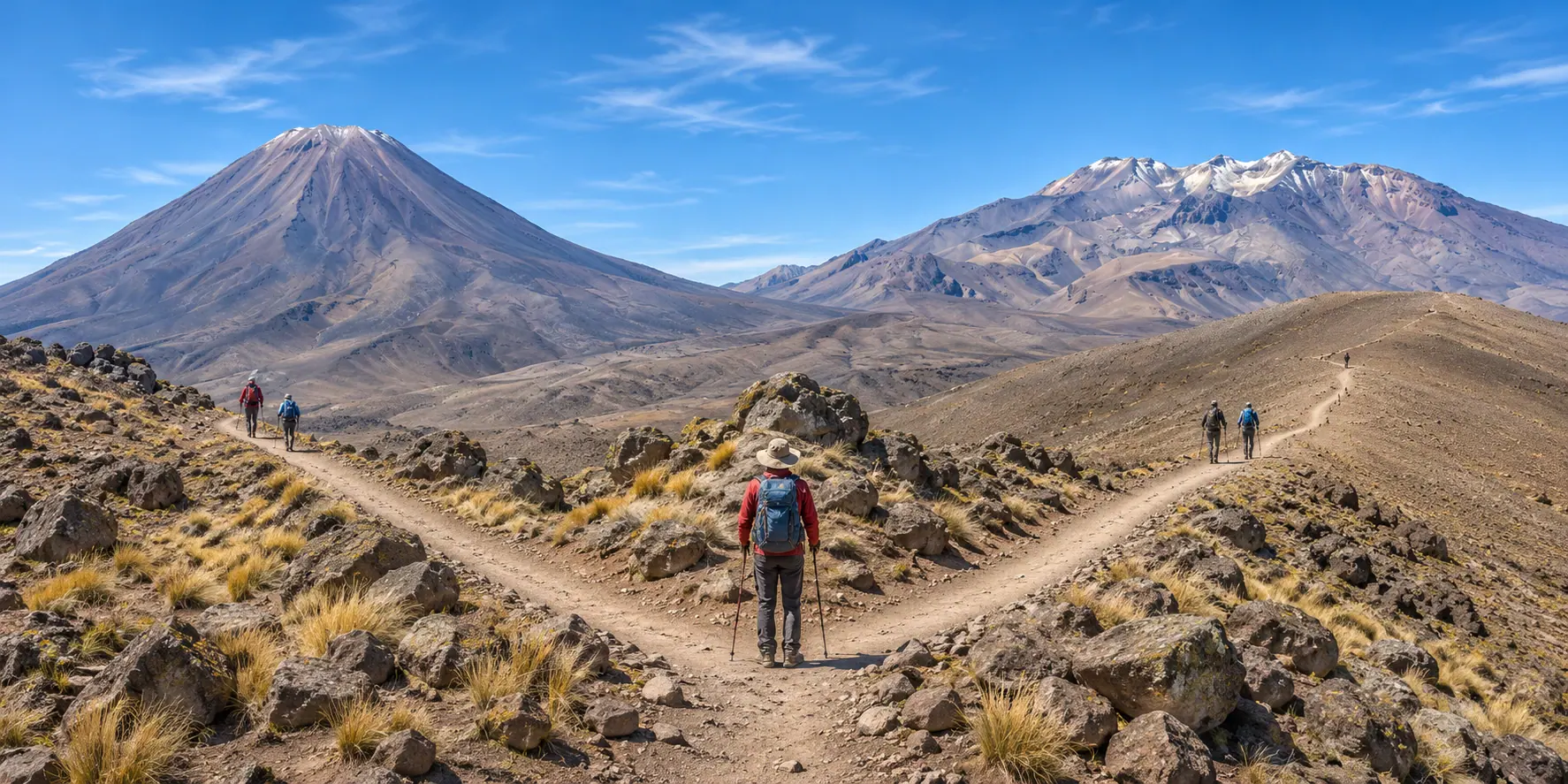
If you’re planning to climb Misti or Chachani, the best time to climb is May to October: clear skies, a low chance of rain and more predictable winds. July and August have the best conditions. Turismo Liberty runs a Misti climb and a Chachani climb, both 2 days and 1 night, with a UIAGM guide, porters, 4×4 transport, meals, tents, crampons and ice axes, and pickup from your hotel in Arequipa at 9:00 AM.
This guide compares both volcanoes month by month, shows what each tour includes and what it doesn’t, walks you through the itinerary and explains how much time you need to acclimatize. If you already have a date, message us on WhatsApp: we confirm availability and the current price within minutes.
⚡ Misti or Chachani: which one fits the season?
Both volcanoes share the same good-weather window, so the month doesn’t decide which one to climb — your altitude experience does. This table shows what actually changes between them.
| Factor | Misti | Chachani |
|---|---|---|
| Summit elevation | 5,822 m | 6,090 m |
| Dry season | March to November | March to November |
| Ideal months | May to October | May to October |
| Best conditions | July and August | July and August |
| Duration | 2 days / 1 night | 2 days / 1 night |
| Camp | Quechua Base Camp, 4,610 m | Campo Inca, 5,250 m |
| Acclimatization in Arequipa | At least 2 days | 2 to 3 days |
| Best for | First high-altitude climb | First six-thousander |
🗺️ What’s included, where it starts and how long it takes
Before picking a date, it helps to know what you get and what to bring. Both climbs work the same way: 2 days and 1 night, groups of 3 to 12 people, a moderate fitness level, a guide in English and Spanish, and a night in tents. They leave Arequipa with hotel pickup at 9:00 AM and return before 5:30 PM on day 2. The current price of each climb is confirmed on WhatsApp together with availability for your date.
✅ What’s included
- Official UIAGM mountain guide, internationally accredited
- Porters, depending on group size
- 4×4 transport with hotel pickup in Arequipa
- Full meals
- Two-person tents
- Crampons and ice axes
- Hot-water flask and complete kitchen utensils
- First-aid kit, communication radios and a satellite phone for emergencies
❌ What’s NOT included
- Sleeping bag
- Warm clothing and boot covers
- Sunglasses, headlamp and trekking poles
- Trekking boots
- Large backpack and small summit daypack
📅 Month-by-month calendar: when to climb Misti and Chachani
This table summarizes how each month behaves around both volcanoes, based on Turismo Liberty’s experience in Arequipa.
| Month | What to expect | Verdict |
|---|---|---|
| January – February | Rainy season with frequent fog | Not recommended |
| March – April | End of the rains, very green scenery | Acceptable with caution |
| May – June | Dry season, clear skies | Excellent |
| July – August | High season, optimal conditions | The best time |
| September – October | Dry season, fewer tourists | Very good |
| November | Occasional rain early in the month | Acceptable |
| December | Rain and storm risk | Not recommended |
At the summit it drops to between -5 °C and -15 °C, and at Misti’s base camp nights fall to around -5 °C. These are general reference figures that don’t change much between months, so pack warm clothes on any date. Other guides frame the best window slightly differently, for example April to November for Misti: the differences are in the edge months, which are the most sensitive to weather.
⛰️ How the climb works: Misti and Chachani itineraries
Both itineraries last 2 days and 1 night. What changes is the starting point, the height of the camp and the length of the hikes.
🌋 Misti (5,822 m)
- Day 1, 9:00 AM — Departure from Arequipa by 4×4 to the start of the climb, at 4,200 m.
- A hike of about 4 hours, with a gradual ascent to Quechua Base Camp at 4,610 m. It’s an ideal climb to acclimatize at an easy pace.
- Lunch on the trail, camp setup, dinner and a briefing from the guide about the next day’s ascent.
- Day 2 — Early breakfast and a final ascent of 5 to 6 hours to the summit, usually reached before midday.
- Descent to the vehicles and return to Arequipa before 5:30 PM.
🏔️ Chachani (6,090 m)
- Day 1, 9:00 AM — Departure from Arequipa by 4×4 to the end of the road at about 5,100 m, with a box lunch.
- A hike of about 2 hours along the Inca trail to Campo Inca at 5,250 m, with gradual progression.
- Tent setup, hot dinner and a night in camp.
- Day 2 — Very early, after breakfast, final ascent along the north face to the summit.
- Time for photos, then a descent to camp and the trailhead in about an hour and a half, and a return to Arequipa before 5:30 PM.
🎒 Acclimatization and what to pack for Misti or Chachani
Arequipa sits at 2,335 m. For Misti, spend at least 2 days in the city before climbing; for Chachani, 2 to 3 days. If you’re coming from sea level, 3 days is ideal. Use that time for easy sightseeing, like the Yanahuara and Carmen Alto lookouts in our guide to Arequipa viewpoints.
- Thermal clothing, windbreaker, gloves, hat and buff
- Cold-rated sleeping bag (rentable in Arequipa)
- Trekking boots you’ve already broken in
- Headlamp with spare batteries
- Sunglasses and sunscreen
- Small daypack for summit day
- Trekking poles
❓ Frequently asked questions about the best time to climb Misti and Chachani
The dry season runs from March to November, and the best window to climb Misti and Chachani is May to October, with clear skies, low chance of rain and more predictable winds. July and August offer the best conditions but are also the most in-demand months, so book 7 to 10 days in advance. In January, February and December the climb is not recommended because of rain, frequent fog and the risk of thunderstorms. March, April and November are transition months: you can climb with caution and a close eye on the forecast.
The current price of the 2-day / 1-night Misti or Chachani climb with Turismo Liberty is confirmed on WhatsApp together with availability for your date. Message us your date and group size and we reply in under 5 minutes. The price includes a UIAGM mountain guide, porters, 4×4 transport, full meals, two-person tents, crampons and ice axes.
Both 2-day / 1-night climbs include an official UIAGM mountain guide, porters depending on group size, 4×4 transport with hotel pickup in Arequipa, full meals, two-person tents, crampons and ice axes, a hot-water flask, kitchen utensils, a first-aid kit, communication radios and a satellite phone for emergencies. Not included: sleeping bag, warm clothing, boot covers, sunglasses, trekking poles, headlamp, trekking boots and backpacks. Some personal gear can be rented in Arequipa, subject to availability.
The Misti and Chachani climbs with Turismo Liberty depart from Arequipa with hotel pickup at 9:00 AM on day 1. On Misti, the 4×4 reaches the trailhead at 4,200 m and you hike about 4 hours to Quechua Base Camp at 4,610 m. On Chachani, the 4×4 goes up to about 5,100 m and you hike roughly 2 hours to Campo Inca at 5,250 m. On day 2 you start very early, make the final ascent and return to Arequipa before 5:30 PM.
It is not recommended during the rainy months. From December to February there is rain, frequent fog and a risk of thunderstorms. March, April and November can be acceptable if the forecast cooperates, but the guide may adjust or cancel the climb because of rain, strong wind or poor visibility, and reaching the summit is not guaranteed on any date. If your trip falls in those months, message us on WhatsApp and we will go over the best option with you.
For a first high-altitude climb, Misti is the better choice: its summit is at 5,822 m versus 6,090 m for Chachani, and it needs less prior acclimatization, about 2 days in Arequipa. Chachani is the natural next step, your first six-thousander, and suits you if you have already hiked above 4,500 m, with 2 to 3 days of acclimatization. Neither requires climbing technique, and the ideal season is the same for both, May to October.
Choosing the right season for Misti and Chachani is what separates a comfortable climb from a difficult one. If you want more adventure after the summit, check out the Chachani downhill ride, the complete Misti guide and the rest of our tours in Arequipa. Message us and we’ll help you pick a date.
Ready to climb Misti or Chachani?
Tell us your date and we’ll confirm availability and the current price on WhatsApp.