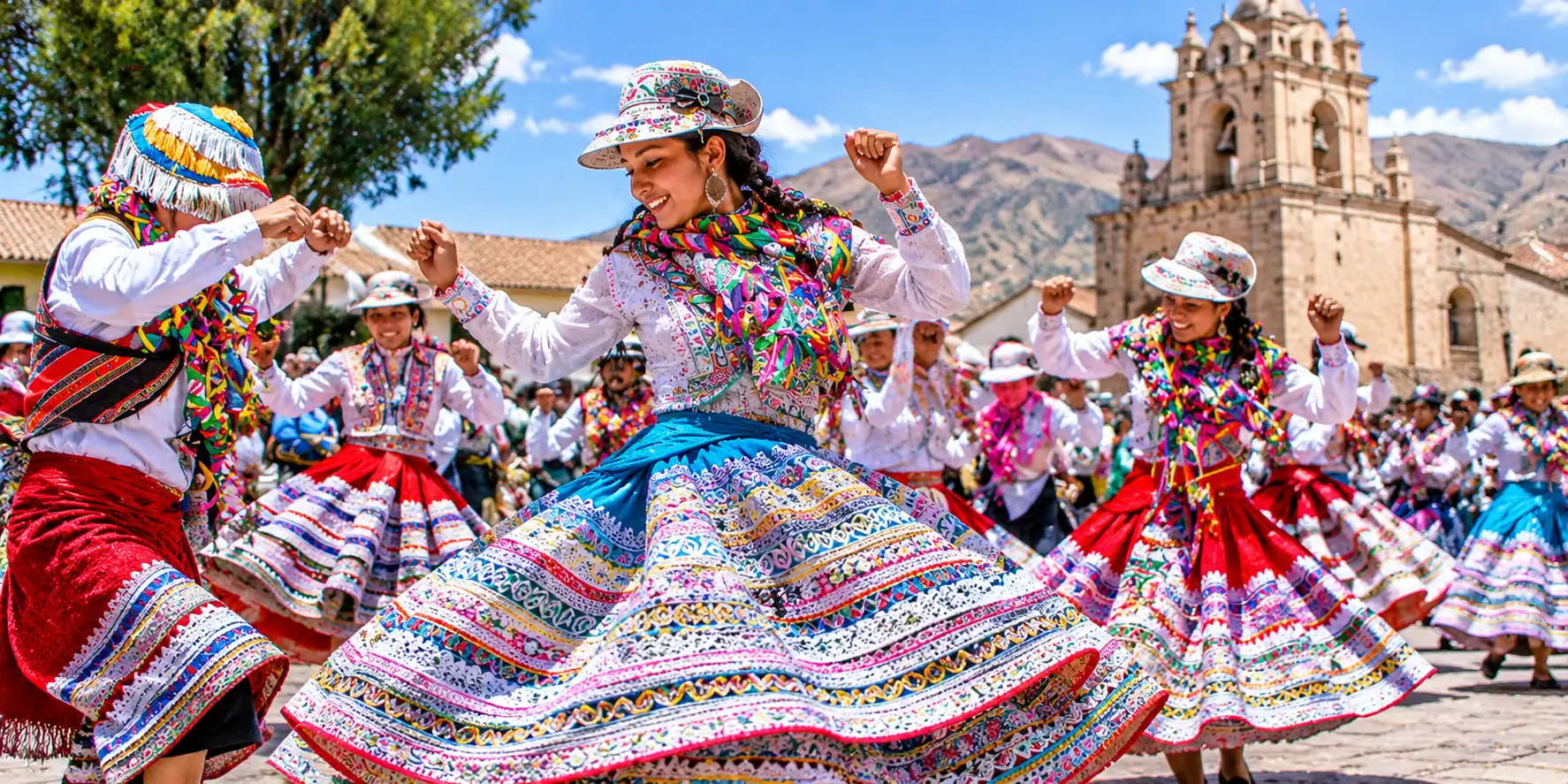
Every December the main square of Chivay fills with embroidered skirts, felt hats and music. That is the Wititi dance, the best-known dance of Peru’s Colca Valley and now part of UNESCO’s Intangible Cultural Heritage of Humanity. If you want to know what it means, why it is performed, how many days the festival lasts and what happens each day, this guide puts it all in order. To experience the valley on those dates, Turismo Liberty runs the Colca Canyon 2 Days and 1 Night tour, with a night in Chivay. Message us on WhatsApp +51 959 175 901 for the price and availability on your date, and we reply in under 5 minutes.
The festival honors the Virgin of the Immaculate Conception and usually runs five days, December 7 to 11. In 2026 the 8th falls on a Tuesday (a national holiday), so many travelers plan a three- or four-day trip around it. One caveat: the official 2026 program had not been published when we wrote this guide, so we describe what happened in earlier editions and how to confirm the schedule.
🎉 Colca 2-Day Tour for the Festival: Inclusions and Departure Point
Here are the facts on the tour Turismo Liberty recommends if you want to sleep in Chivay, the town at the heart of the festival:
| Detail | Information |
|---|---|
| Tour | Colca Canyon 2 Days and 1 Night | Andean Adventure |
| Price | Ask on WhatsApp for your travel date |
| Duration | 2 days / 1 night in Chivay (3-star hotel or lodge) |
| Starting point | Pickup at hotels in Arequipa’s historic center from 7:30 AM |
| Return | Around 5:30 PM on day 2, near Arequipa’s main square |
| Included | Tourist transportation, hotel pickup, certified guide, 1 night hotel, breakfast on day 2, ongoing assistance |
| Not included | Lunches and dinners, Colca Valley entrance fee and hot springs |
| Valley entrance fee | Peruvians S/. 20 · Latin Americans S/. 40 · foreigners S/. 70 · Peruvian students S/. 5. Hot springs: S/. 15 |
| Difficulty | Moderate · maximum altitude 4,900 m (16,076 ft) · groups of up to 18 |
💃 What Is the Wititi Dance? The “Dance of Love” of the Colca Valley
The Wititi is a traditional dance from the Colca Valley in Arequipa, often called the “dance of love.” According to UNESCO, it is a courtship ritual linked to the passage into adulthood. Young people perform it during religious festivals in the rainy season, as the agricultural cycle begins, and it symbolizes the renewal of nature and society.
It is inherited from two native peoples of the valley, the Cabana and the Collagua, so it is also a meeting point between both cultures. UNESCO inscribed it on December 2, 2015 on the Representative List of the Intangible Cultural Heritage of Humanity; you can read the official entry on the UNESCO website.
⛪ Why Is the Wititi Performed? Faith, Planting and Courtship
The Wititi is danced as part of the festival of the Virgin of the Immaculate Conception, patron of Caylloma province. Three reasons blend together in this celebration:
- Religious: it is Chivay’s most important festival, with mass, a procession and the Virgin’s visits to the altars.
- Agricultural: the Virgin is asked to bring rain at the start of the planting season, and the “tinkado” (an offering to the earth) is made before the altars are built.
- Courtship: the dance represents young people’s courtship and their step into adult life.
🗓️ How Many Days Does the Wititi Festival Last, and What Happens Each Day?
The Immaculate Conception festival in Chivay lasts five days. In 2022 and 2024 it ran December 7 to 11; for 2025 Autocolca announced “December 7 to 12,” although the main events closed on the 11th. This is the typical program from those editions, not the official 2026 program:
- December 7 — altars, arches and offering to the earth: at midday the altars and arches go up in Chivay’s main square and the tinkado is performed. The parcialidades (neighborhood groups) of Anansaya, Urinsaya and Capa build their altars, and the faithful attend the eve mass. This is also National Wititi Day, with events in the city of Arequipa too.
- December 8 — the main day: mass and procession at 11:00 AM in Chivay. The Virgin passes under each arch and stops at each altar. At night, at 10:30 PM, a traditional entrance and greeting to the Virgin takes place.
- December 9 — Wititi contest: in 2024 the “Llapanchis Tusuykusun” contest was held at the La Montera covered arena, along with a parade through Chivay.
- December 10 — the parcialidades: the Anansaya, Ccapa and Urinsaya groups present themselves with a parade.
- December 11 — grand finale: the Gran Wititiada, a general dance in honor of the Virgin that closes the festival.
The festival is organized by Autocolca (the Colca Autonomous Authority) and the Provincial Municipality of Caylloma together with Chivay’s parcialidades. About 5,000 tourists were expected in 2024, and Autocolca projected more than 15,000 for 2025. Sources spell the parcialidades’ names in several ways (Anansaya/Hanansaya, Capa/Ccapa); we use the most common spelling.
National Wititi Day was declared in 2024 through Law No. 32174, according to the press: every December 7 the dance is celebrated nationwide. Schedules change every year, so confirm them with the Provincial Municipality of Caylloma or on the Autocolca website.
👗 Costume and Meaning: Why Do the Men Wear Skirts?
The central character is the wititi, a man who dances in two layered women’s skirts, a shirt, a sling and a montera hat. For some, the hat symbolizes the man’s attempt to hide; for others, the skirt belongs to the courtship ritual or is a pre-Hispanic legacy. The women wear finely embroidered costumes with nature motifs and characteristic hats, and the embroidery and music fill the whole square during the festival days.
🏔️ A Tradition Passed Down From Generation to Generation
What makes the Wititi special is that it is still alive: families, dance groups and parcialidades in the valley keep it going from generation to generation, and today it is the most representative dance of the Colca. UNESCO’s recognition in 2015 strengthened local pride, and Autocolca is pushing to include the dance in regional and national education. It is Peruvian heritage recognized worldwide, and seeing it where it was born is very different from watching it on a stage.
🚌 How to Get to Chivay: Which Option Fits You
| Aspect | 2 days / 1 night tour | Full Day |
|---|---|---|
| Duration | 2 days, night in Chivay | 1 day, back in Arequipa the same day |
| Afternoon and evening activities | Yes, because you sleep in Chivay | Unlikely, because you return the same day |
| Cruz del Cóndor viewpoint | Yes, on day 2 | Yes |
| Best for | Experiencing the festival at a relaxed pace | A quick visit to the valley |
If you are torn between the two, read our comparison Colca Canyon tour: 1 day vs 2 days. For a different, slower way to see the valley, see our Colca experiential tour.
Here is the base itinerary of the 2-day tour:
- Day 1 — Arequipa to Chivay: pickup from 7:30 AM, a route through the Salinas and Aguada Blanca National Reserve (vicuñas), a stop at Patahuasi, the Mirador de los Volcanes at Patapampa (4,900 m) and arrival in Chivay around 1:30 PM for lunch. In the afternoon, hotel check-in and the Chacapi hot springs in Yanque; dinner with a folk show and overnight in Chivay.
- Day 2 — Cruz del Cóndor and return: breakfast at the hotel, the Cruz del Cóndor viewpoint, a visit to Yanque and Maca, lunch in Chivay and arrival in Arequipa around 5:30 PM.
🌧️ Colca in December: Rain, Skies and What to Expect
December is rainy season in the Andes, and that is when the Wititi is danced, according to UNESCO. The tour page lists March to November as the best season, so in December bring a rain jacket and some flexibility: weather can affect views such as the one at Cruz del Cóndor. For a month-by-month view, read our best time to visit Arequipa and Colca Canyon guide, and for more ideas see things to do in Arequipa in 2026.
🎒 What to Pack and How to Behave During the Festival
- Rain jacket or poncho — December is rainy season.
- A warm layer for the evening — Chivay sits at about 3,600 m (11,800 ft) and gets cold after dark.
- Sunscreen and a hat — UV radiation at altitude is strong, even when it is cloudy.
- Cash in Peruvian soles — for entrance fees (S/. 20 to S/. 70 depending on nationality), hot springs (S/. 15) and meals.
- Ask before photographing people — the dancers are taking part in a religious and cultural act, not a show.
- Respect altars and processions — do not cross the procession’s path or touch the arches and altars.
❓ Frequently Asked Questions About the Wititi Dance
The Wititi is a traditional dance from the Colca Valley in Arequipa, Peru, also called the “dance of love.” According to UNESCO, it is a courtship ritual tied to the passage into adulthood, performed by young people during religious festivals in the rainy season, and it symbolizes the renewal of nature and society. In Chivay it is danced during the festival of the Virgin of the Immaculate Conception each December. It is the most representative dance of the Colca and was inscribed by UNESCO in 2015 as Intangible Cultural Heritage of Humanity. Turismo Liberty offers the Colca Canyon 2 Days and 1 Night tour to visit the valley where it was born.
The Immaculate Conception festival in Chivay lasts five days. In 2022 and 2024 it ran from December 7 to 11, with the main day on the 8th: mass and a procession at 11:00 AM and a traditional entrance at night. A Wititi contest is usually held on the 9th, the parcialidades present themselves on the 10th, and the Gran Wititiada closes the festival on the 11th. In 2025 the dates were announced as “7 to 12,” though events closed on the 11th. The official 2026 program was not published when we wrote this guide, so confirm times with the Provincial Municipality of Caylloma or Autocolca.
The main character, the wititi, is a man who dances in two layered women’s skirts, a shirt, a sling and a montera hat. No single explanation is proven. One version says the skirt recalls a pre-Hispanic courtship custom; another, reported by Andina, says it was a defensive tactic against outside enemies, which is why the dance also represents the strength and spirit of the local people. What is certain is that the costume is an essential part of the courtship ritual recognized by UNESCO. On Turismo Liberty’s Colca tour you can ask your local guide about these stories.
National Wititi Day is December 7 every year. According to the press, it was declared in 2024 through Law No. 32174, and it coincides with the first day of the Immaculate Conception festival in Chivay. On that day the altars and arches go up and the offering to the earth is made in Chivay, and the city of Arequipa holds activities such as parades, a photo exhibition of the valley and a dance contest. We could not read the text of the law, so we recommend confirming details with official sources such as Autocolca or Peru’s Ministry of Culture.
Turismo Liberty’s Colca Canyon 2 Days and 1 Night tour has a rate that varies by date, so we confirm it on WhatsApp: message us if you travel on December 8 or 9 and we reply in under 5 minutes. The tour includes tourist transportation, hotel pickup, a certified guide, one night in a hotel in Chivay and breakfast on day 2. It does not include lunches, dinners or the valley entrance fee: S/. 20 for Peruvians, S/. 40 for Latin Americans, S/. 70 for foreigners and S/. 5 for Peruvian students, plus S/. 15 for the Chacapi hot springs.
Turismo Liberty’s Colca Canyon 2 Days and 1 Night tour departs from Arequipa. Pickup is at hotels in the historic center from 7:30 AM, and on day 2 the return reaches Arequipa around 5:30 PM near the main square. The route passes the Salinas and Aguada Blanca National Reserve, the Mirador de los Volcanes (4,900 m), Chivay, the Chacapi hot springs, the Cruz del Cóndor viewpoint, Yanque and Maca. Groups are up to 18 people and the physical level is moderate, with a certified guide in Spanish and English.
Understanding the Wititi dance changes how you see the valley: behind every embroidered skirt there is faith, planting, courtship and a tradition that Colca families keep alive. Turismo Liberty takes you to Chivay with the Colca Canyon 2 Days and 1 Night tour, with a certified guide, hotel and pickup in Arequipa.
Ready to experience the Wititi in the Colca?
Turismo Liberty’s Colca Canyon 2 Days and 1 Night tour includes a certified guide, a hotel in Chivay and pickup in Arequipa. Message us your December date on WhatsApp and we send you the price and confirm availability. No middlemen.