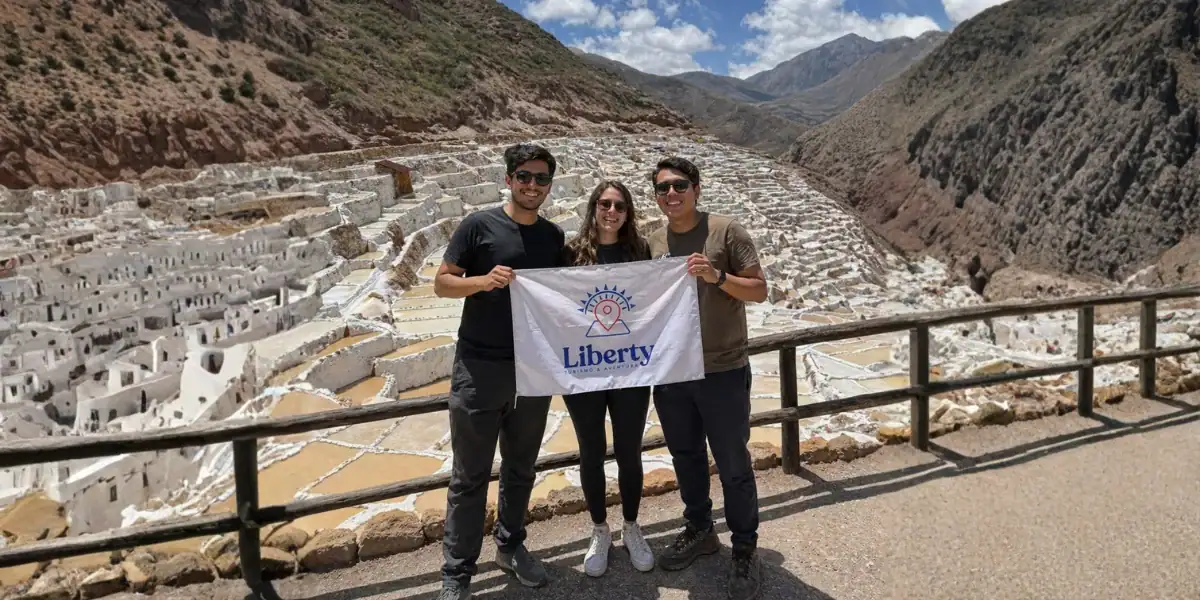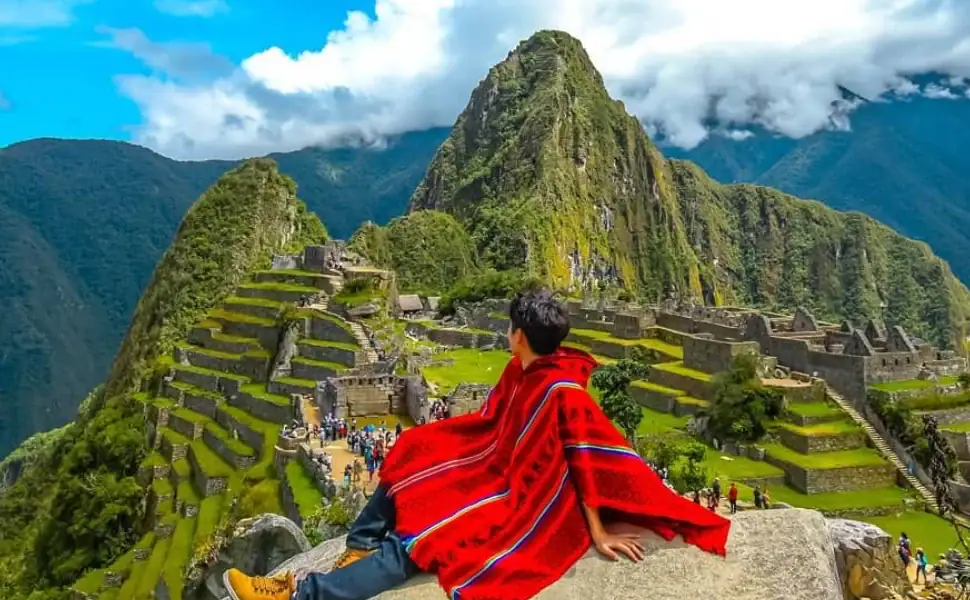
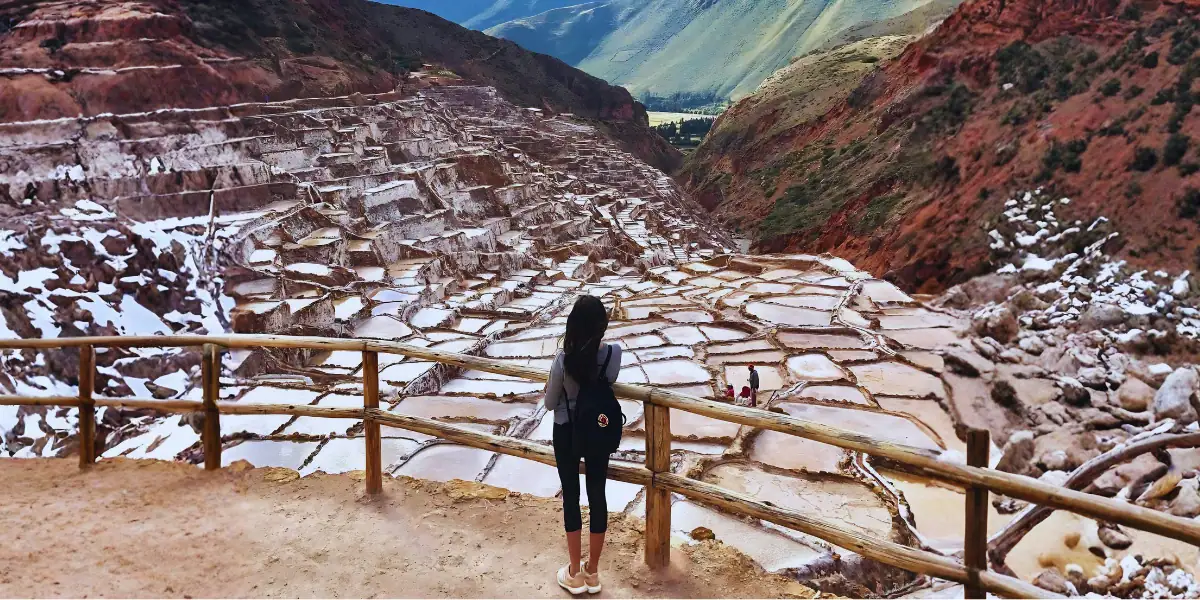
Forty-six kilometers northwest of Cusco, carved into the slope of Qaqawiñay hill at 3,200m elevation, more than 3,000 salt evaporation pools form one of the most visually striking landscapes in all of South America. The Maras Salt Mines are not a modern tourist attraction: they are a salt extraction system that has been operating since before the Inca Empire, managed today by 800 local families. The Maras Salt Mines tour from Cusco with Turismo Liberty starts from $35 USD per person for the half-day, or as part of the full Sacred Valley tour from $55 USD including a buffet lunch.
The tour combines the salt mines with the circular terraces of Moray — the Inca agricultural laboratory where over 250 plant species were cultivated using different microclimates. In half a day, you visit two of the most photogenic and underrated sites in the Sacred Valley. Altitude drops from 3,399m in Cusco to 3,200m at Maras: ideal for day two or three of your stay, when your body is already adjusting.
🧂 Maras Salt Mines Tour with Turismo Liberty: price & what’s included
| ✅ Included in the tour | ❌ Not included |
|---|---|
| Hotel pickup in central Cusco | Guide gratuity (optional) |
| Round-trip tourist transport | Drinks during the tour |
| Certified bilingual guide (EN/ES) | Artisan products from local producers |
| Guided visit to the Maras Salt Mines | Personal travel insurance |
| Guided visit to Moray circular terraces | Lunch (included in full-day tour only) |
| All entry fees (Salt Mines S/20 + Tourist Ticket) |
🏔️ What exactly are the Maras Salt Mines?
The Maras Salt Mines are a complex of over 3,000 evaporation pools cut into the slope of Qaqawiñay hill, at 3,200m elevation in the Sacred Valley of the Incas. A natural saltwater spring — the Qoripujio spring — flows from the hilltop through an ancient network of distribution channels and continuously fills the pools. The sun does the rest: it evaporates the water and leaves crystallized salt behind.
What makes Maras unique is its age and uninterrupted continuity. The system dates to the pre-Inca era and works exactly the same way today: no machinery, no chemicals, no modifications to the original hydraulic design. The 800 families of the local Maras community each own their individual pools — some passed down through generations — and sell their salt directly to visitors.
Moray, about 7 km from the salt mines, is the perfect complement. Its concentric circular terraces (the deepest level sits 30 meters below the rim) were used by the Incas as an agricultural laboratory: the temperature difference between the top and bottom terraces can reach 15°C, allowing them to simulate different climates and adapt crops from across the empire.
🕗 Maras Salt Mines tour itinerary: hour by hour from Cusco
🎫 Entry fees & real prices: what nobody explains before you arrive
| Site | Entry fee | Included in Tourist Ticket? | Payment |
|---|---|---|---|
| Maras Salt Mines | S/20 (~$5 USD) non-residents | ❌ No — independent entry | Cash in soles, on-site |
| Moray | Included in PTT (S/70) | ✅ Yes — Partial Tourist Ticket | With Tourist Ticket |
| Partial Tourist Ticket | S/70 foreigners | — (Circuit 3: Sacred Valley) | Cash in soles |
| Full Tourist Ticket | S/130 foreigners | — (16 sites, 10 days) | Cash in soles |
⚖️ Half-day vs full-day: which one to choose
| Option | Duration | Sites | Price | Best for |
|---|---|---|---|---|
| Half-day (Maras + Moray) | 4–5 hours | Salt Mines + Moray | From $35 | Already did the classic Sacred Valley |
| Full-day Sacred Valley | 7–9 hours | Pisac + Maras + Moray + Ollantaytambo + lunch | From $55 | First excursion outside Cusco |
| Sacred Valley VIP | 8–9 hours | Chinchero + Maras + Moray + Pisac + Ollantaytambo | From $65 | Want to see everything in one day |
| 5-Day Cusco Package | 5 days | City tour + Sacred Valley + Maras + Machu Picchu | From $789 | First-timers who want a stress-free trip |
📸 Insider tips nobody tells you before visiting Maras
- You can no longer walk between the pools: For conservation and safety reasons, it has been prohibited for several years to descend and walk among the ponds. The visit is done from elevated viewpoints along the upper path — equally impressive, and the bird’s-eye angle is exactly the shot you’ve seen go viral online.
- Best photo angle: upper-left trail viewpoint: When you enter, follow the path right and climb to the highest lookout point. From there you get the full cascading perspective of all 3,000 pools. Arrive between 9:00 and 10:00 AM for the best light.
- The pre-Inca canal system that most visitors walk past: Most tourists rush by without noticing the irrigation channels feeding the pools from the Qoripujio spring above. A knowledgeable guide explains how this system has run unchanged for over 1,000 years — one of the oldest hydraulic engineering works in the Americas.
- Rainy season changes the color of the pools: From November to April, rain mixes mud into the salt water, turning the pools ochre and terracotta. It’s a different kind of beautiful — but if you want the classic bright white, travel between May and October.
- Buy salt directly from the producers: At the end of the trail, families sell their artisan salt with no middlemen. Prices are far lower than in Cusco markets and 100% of the money goes to the community. A 500g bag costs S/10–15 — the most authentic souvenir Cusco has to offer.
🎒 What to bring to the Maras Salt Mines: complete packing list
- SPF 50+ sunscreen (mandatory): At 3,200m elevation UV radiation is 30% stronger than at sea level. The salt pools reflect sunlight like a mirror — you can burn in under 40 minutes without protection
- UV-filter sunglasses: The reflection off the white salt water multiplies sun exposure significantly at this altitude
- Layered clothing: Mornings in Cusco can be cold (8–12°C) and warm up quickly on-site. A t-shirt + light fleece + windbreaker is the ideal combination
- Closed-toe shoes with good grip: The trail at the Salt Mines is uneven with rocks and small slopes. Technically easy, but good traction prevents slips
- Water (at least 1 liter): There are no vendors inside the Salt Mines complex. Bring enough for 2 hours on-site
- Peruvian soles in cash (S/30–50): For the entry fee (S/20) and to buy salt from producers. No card readers or ATMs on-site
- Charged camera or smartphone: The Salt Mines are among the most photogenic places in all of Peru. Bring a full battery — or a power bank
- Original passport: Required to enter archaeological sites in Peru. Copies or phone photos of documents are not accepted
- Snack or early lunch (half-day tour): The half-day tour does not include lunch. Eat before you leave or bring a snack. The full-day Sacred Valley tour includes a buffet lunch in Urubamba
❓ Frequently asked questions — Maras Salt Mines tour from Cusco 2026
The entry fee is S/20 per person for non-residents of Peru (approximately $5 USD). It is paid on-site in cash, in Peruvian soles only — no credit cards or US dollars accepted. This entry is not included in the Cusco Tourist Ticket and is managed independently by the local Mara Sal community.
No. The Salt Mines have their own independent S/20 entry fee. Moray is included in the Partial Tourist Ticket (PTT, S/70 per person, valid 2 days). If you already bought the Full Tourist Ticket (S/130), Moray is covered — you only need to pay the S/20 Salt Mines entry separately. When you book with Turismo Liberty, we tell you exactly what to bring before departure.
The half-day tour takes 4–5 hours total including a 45-minute drive each way. On-site time is approximately 45–60 minutes at the Salt Mines and 45 minutes at Moray. The full-day Sacred Valley tour with Maras runs 7–9 hours and also includes Pisac, a buffet lunch and Ollantaytambo.
May to October (dry season) is ideal: clear skies, intense sun that makes the pools gleam bright white, and active salt harvesting from May to September. In the rainy season (November–April) the pools take on ochre and brown tones — still photogenic but very different. In any season, arrive before 10:00 AM for the best light.
Yes. From Cusco take a colectivo on Calle Pavitos to the Maras highway junction (S/10–15 per person), then hire a taxi to both sites for around S/50 (ask the driver to wait). The main challenge is finding a taxi back in high season when vehicles are scarce. An organized tour eliminates that stress and adds a bilingual guide — especially valuable at Moray, where the Inca engineering is not obvious without explanation.
Wear comfortable layered clothing: a t-shirt, light fleece and windbreaker cover all conditions. Closed-toe shoes with a firm, non-slip sole are essential as the trail is rocky and uneven. SPF 50+ sunscreen and UV-filter sunglasses are mandatory — the reflected light off white salt at 3,200m is intense. A wide-brim hat adds extra protection during the 45–60 minutes on-site.
The Maras Salt Mines are one of those places that resist easy categorization: not purely archaeology, not purely nature, not purely living culture — all three at once. The same families who cared for these pools for generations are still working them today using the same channels designed by pre-Inca engineers over 1,000 years ago. The Maras Salt Mines tour from Cusco with Turismo Liberty is the smartest way to combine them with Moray and the rest of the Sacred Valley, guided by a local specialist who can explain what no information panel ever could.
Ready to book the Maras Salt Mines tour from Cusco?
Daily departures from Cusco · From $35/person · Bilingual guide · Entry fees included · Half-day or full-day